
I tapped the glass of my compass frantically, but it was useless. The brass needle swung wildly, first clockwise before snapping back into a counterclockwise whirl.
Squinting up at the sky, I was desperate for the slightest glimpse of the watery sun, anything to give us an indication of our heading. But there was nothing, just the white, impenetrable shroud of fog pressing down on us.
Then, drifting through the still air, a faint clang reached my ears. The distant, muted sound of a ship’s bell. Once, twice… eight times its heavy, muffled chime drifted across the lifeless water.
“Eight tolls for eight dead men,” Thomas said grimly, stepping onto the quarterdeck. His crippled leg dragging behind him while his cane thumped in time with the bell. “The ghosts are calling, Captain.”
“Don’t be ridiculous, Phillips!” I snapped, though my voice carried less conviction than I wanted. “It’s just that English wreck shifting in the ice. What news of the boy? I assume that’s why you’re here—to tell me something of importance, not spread superstitious rumours.”
“Indeed, Captain.” His eyes drifted warily out to the blanket of fog before returning to mine. “The frostbite has got him bad. I’m going to have to take off his feet and one hand. But he’ll live.”
“Has he told you what happened out there? Anything of the crew?”
“He’s said nothing, Captain,” Thomas replied, the breath misting in front of his face. “All he’s told me is that his name is Samuel, and his brother was Edward. But whenever I ask about the ship or crew, he just stares at the deck and repeats the same thing, ‘help my brother’.”
“Get your saws ready then and take some of the brandy from the stores. He’ll need it. He’s been through hell.”
Thomas nodded sharply before walking away.
“Best drop anchor, Captain,” Jens’ voice rasped suddenly from behind me. “Can’t sail in this. Can’t see a thing. But it gives us a chance to fetch that whale oil.”
The thick fog closed in tightly around us, wrapping us in its icy tendrils as I turned to see my first mate climbing onto the quarterdeck.
“The oil is gone!” I said, my voice cracking like a jib in the wind. “You said it yourself. Staying out here is suicide, and I won’t risk any more lives. The current is pulling the pack ice south. If we drop anchor here, by this time tomorrow we’ll be locked in. We’ll let her drift south with the floes. As soon as the fog clears, we’ll set course for home.”
Jens didn’t blink; his eyes locked onto mine with a freezing glare.
Nils shifted his feet, his gaze darting between the two of us, his lips pressed into a thin, white line. He didn’t need to speak. I knew what was on his mind, and it was the same fear that nagged at the back of my own head.
“Just keep the watch tight,” I barked at him before turning on my heel and striding towards the main deck and the midship companionway.
The East Spitsbergen Current would sweep us south into clear waters, away from the ice. But from our last known position, that put the sheer cliffs and treacherous rocks of Bear Island, only sixty miles south, directly in our path. At our current rate, it would take two days to reach; by then the fog would have cleared, or we would have passed whatever anomaly was interfering with the compasses.
The sharp crack of a pistol from the crow’s nest shattered the silence and caught my attention. Instinctively, I began a slow count in my head. One, two… ten before the echo rolled back over the ship.
“Ice at one mile,” came the call from atop the mast.
A safe distance. For now.
****
The low muttering that had filled the midship fell silent as my boot stepped down from the last rung of the ladder.
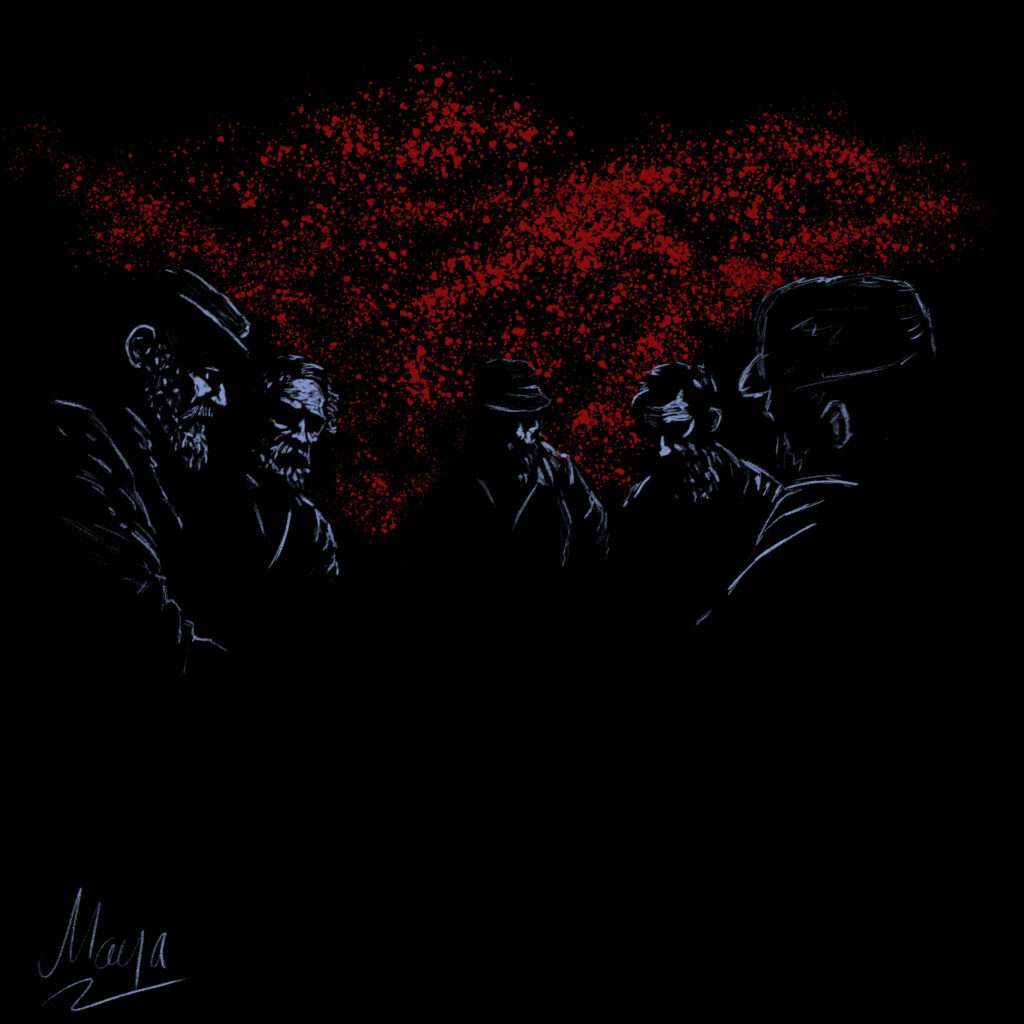
The pungent, sweet smell of tobacco smoke filled the cramped space of the steerage deck. It was a blue haze that drifted from the clay pipes of the five men sitting around the large, roughly hewn table.
The Larson twins looked up at me while Thomas tapped out the blackened contents of his pipe onto the tabletop. The other two, their faces shadowed by low pulled caps, kept their gazes fixed on the steaming tin mugs before them, their silence hung heavily.
“Where’s the boy, Thomas?” I said, peeling off my ice-crusted mittens.
“Jonah.” The word was a low, barely audible growl drifting from Erik Larson’s direction.
“Do you have something to say, Erik?” I turned squarely to face the dark-haired man, my hands gripping the rugged edge of the table.
Erik met my gaze with impunity. He didn’t flinch. He didn’t even blink.
“A Jonah,” he repeated, his voice forceful this time. “Everyone’s saying it, Captain. If eight dead crewmen aren’t warning enough, you go and bring a Jonah aboard. He cursed his own godforsaken ship, and now he’s brought that curse here.”
My hands clenched the table tightly, my knuckles turning white, splinters digging into my palms.
“He’s a little more than a boy!” my voice cracking like musket fire. “Would you have me leave him to suffer the same fate as his brother?”
“He’s a child, Erik,” Thomas said softly. “A child whose hands and toes I’ll be sawing off come dawn. I’ll not have you lay another finger on him.”
“You’ve seen what’s happening, Thomas.” Erik retorted sharply, turning on the old naval man with fists clenched. “How else would you explain everything?”
“For the love of God!” I bellowed, slamming my hands down. “Have you never seen fog before? It will clear! The compasses will right themselves. They’ve just lost their bearings; it can happen this far north. Iron deposits in the ice, most likely or a magnetic anomaly.”
“It’s not just the fog or the compasses though, is it?” Johan spoke up beside his brother with a trembling voice.
My eyes naturally snapped back to Thomas.
“What’s going on, Thomas? What has happened?” I said.
The old cook slumped, his weight shifting, causing his chair to creak. He didn’t meet my gaze. Instead, he reached towards his mug of coffee, sliding it across the rough table and towards me with a grating scrape.
Taking the mug, the heat tingling my numb hands, I raised it to my lips. The bitter scent of the coffee filled my nostrils, but there was something else too, something that I couldn’t quite place.
The moment the black liquid hit my tongue, my throat tightened, gagging. It was thick and cloying, coating my mouth with a revolting, violently bitter film. The briny seawater stung my gums and throat so fiercely that I spat the foul concoction across the deck planks.
“What is this?” I screamed, wiping my mouth with the back of my sleeve.
“We drew the water from a fresh cask, one we brought from Tromsø,” Thomas replied. “They’re all the same. Every barrel, it’s all bilge.”
“It’s not just the water, Captain,” Johan said, tipping the contents of a canvas bag onto the table.
More than a dozen hardtack biscuits scattered over the scratched surface with a soggy thwack. Biscuits that had been four times baked, biscuits that should be as hard as stone and able to survive for years aboard ship without spoiling. But these biscuits weren’t their usual light brown colour. Each one a rotting, crumbling mass, covered in a grotesque, velvety black mould. Dark, viscous grease oozed from their edges, leaving glistening, oily stains on the scarred wood of the table.
“Every sack is the same, Captain.”
My gut twisted, bile rising in my throat as I stared at the oily rot.
“A leak?” My voice stammered, my mind scrabbling for an explanation. “The sea must have breached the bread room.”
“And the water barrels too? That’s impossible.” Erik’s sharp tone cut through the heavy air. “The timbers are bone dry. Everything was fine just this morning. Seawater hasn’t done this, Captain. This is the work of something else.”