
15th October
Mr Dickens and Miss Nightingale have returned to me bearing the most troubling of reports. It would appear that the case of the missing Members is not simply one of abscondence but is, in reality and as I had feared, an abduction. There is compelling and highly damning evidence to suggest the involvement of that most wretched of persons who calls himself The Rat King, which, if proved true, would constitute a most flagrant and unforgivable violation of The Truce.
For the present, I will keep this information to only the closest of my confidants. I simply cannot risk word of this reaching the ears of the Ministry of Darkness, for that would without doubt invite a most reckless retaliation. The Empire cannot afford a repeat of the horrors of 1666.
To add to my grave discomfort, further distressing news has just this morning reached my ears. Within this very hour, I have received Commissioner Henderson of the Metropolitan Police, here in my private rooms. While he seems an intelligent and capable individual, he brought grave news indeed. Word of civil unrest spreading through the East End. He pleaded I despatch military intervention to assist the police in containing this disturbance. He even recounted, with the most inappropriate mirth, the reports of certain constables who swore they had witnessed the dead rising from their graves.
While I too find such extraordinary tales highly improbable, a quiet fear has long lingered among certain corners of my government that the Ancient may try to push his influence past the boundaries of London by Dark and into London by Day. Considering this peril together with the peculiar actions of The Rat King, I have, as a measure of utmost precaution, ordered the deployment of a detachment of the Black Watch forthwith. They are a regiment far better suited to this manner of threat than any other in the British Army.
“Sergeant!” said a soft, gentrified voice.
Sergeant Gordon spun on his heel, the hobnailed soles of his highly polished black brogues screeching against the grit-strewn cobbles.
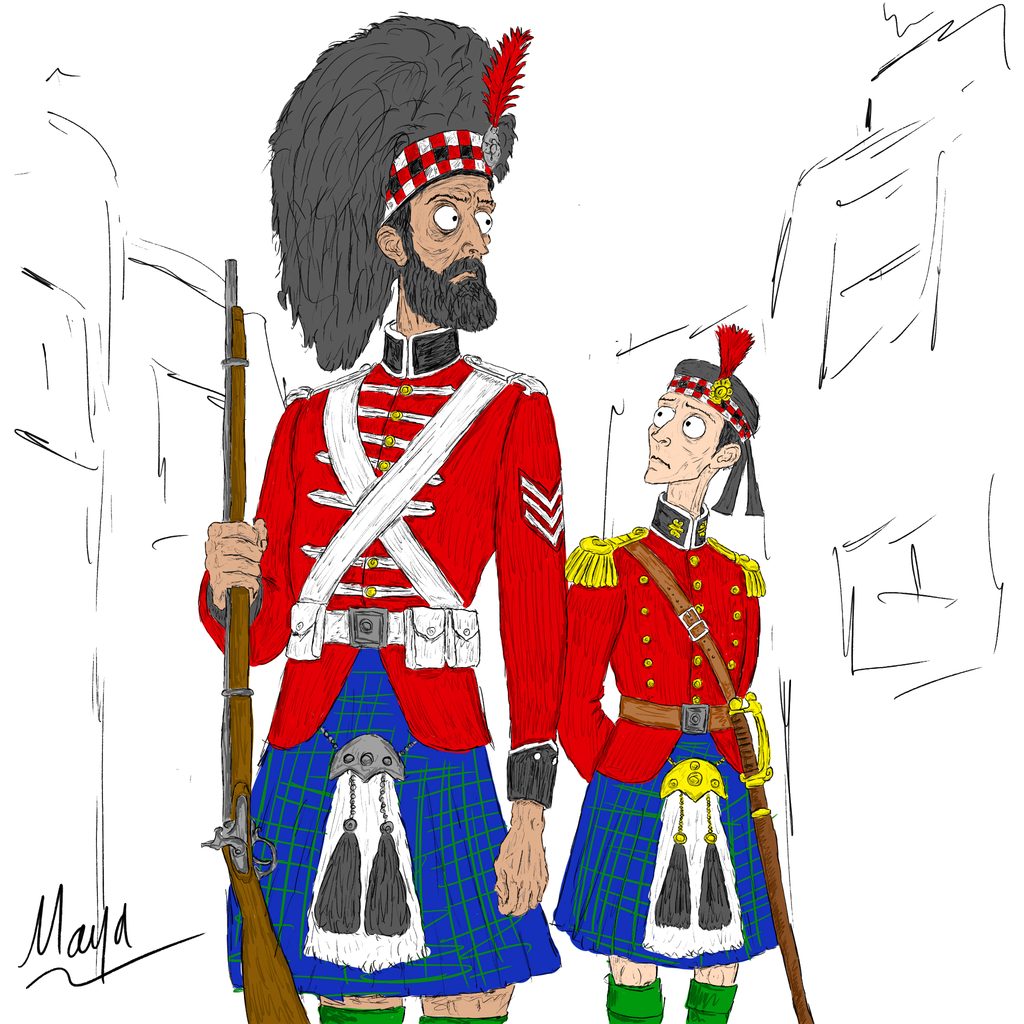
His back snapped into place, straighter and stiffer than a frost-hardened plank of Caledonian pine. His chest puffed out, straining the silver buttons against the bright red wool of his jacket – buttons that were prevented from pinging off like shrapnel only by the bone-white leather belts crossing his front. His hand moved in a well-practiced blur, striking the stock of his rifle in salute with a solid thwack, accompanied by a soft rattle from the iron bars and rowan wood sewn into the thick, heavy pleats of his dark tartan kilt.
“Sir!” Sergeant Gordon’s voice was a sharp crack in the thin yellow mist that swirled around them in the unnaturally still air.
Looking up at him was the ruddy, flushed face of Lieutenant McAllister. The young officer’s neck craned backwards to meet the eyes of the Sergeant, who towered a good eighteen inches taller. The boy looked no more than a day older than Gordon’s own lad, who was probably at that very moment chasing the stubborn geese across the sweet-smelling, heather-covered slopes of their croft near Glenfinnan.
“Set up a barricade across the road. Use whatever you can find, perhaps those wagons,” the soft-voiced officer said, nodding towards a handful of wagons that Sergeant Gordon had already spotted and taken note of as soon as they’d arrived. “Oh, and Sergeant, standard ordnance today.”
The sergeant’s eyes blinked at the command. Had Lieutenant McAllister noticed his nervous twitch? If he had, he didn’t show any signs of having done so; his face remaining entirely smooth.
“Lieutenant, sir?” Gordon’s tongue curled around the words. “All due respect, sir, but standard ordnance? The stories… we don’t know what we’re facing.”
“Standard ordnance, Sergeant,” the Lieutenant repeated the order. “By Major MacCowan’s command. Silver rounds and iron bayonets cost the Crown money, Sergeant.”
“Aye, of course, sir!”
Gordon’s palm struck the stock of his Enfield rifle with a violent force that left his hand stinging. The second salute said everything that his voice dared not.
Major MacCowan, that swell-headed toff, smelling of French cologne and tobacco, had never seen a real conflict in his life. His family’s coin had bought his commission, and now it kept him tucked up safely behind a mahogany desk at Whitehall, as far from the front as he could ever hope to be. He wouldn’t hesitate to throw the Sergeant’s men and this green, young Lieutenant to a very messy end, if it saved a few shillings in the regiment’s ledgers.
“You all heard the Lieutenant, lads,” Gordon’s voice rolled through the fog like a thunderous cannonade, sending a flock of crows scattering from a nearby soot-covered chimney. “Get moving.”
‘Big Dog’ Carter stood before the hulking, green-painted oak doors of the warehouse, shut tightly and bolted firm. The fetid stench and filth of the River Thames stung in his nostrils, a disgusting brew of dead fish and human shit. The putrid green waters oozed by slowly, the wet slapping of the current against the wharves and jetties echoing in the silence. The opposite bank was little more than a dark stain against the thick yellow fog, which sucked the colour from the world and reduced the sun to a pathetic, watery glimmer in the sky.
His hands clenched tightly on the handle of the heavy shovel. He barely even noticed the splinters that dug into his skin, skin that had grown rough, hard and calloused through years of hauling crates off ships and breaking heads in the pubs and backstreets of Wapping.
“What the bloody hell’s going on?” a second man, a whole head taller and about twice as wide as Carter, said in a thick, gravelly Irish lilt which seemed to boom from deep within his barrel-like chest.
“How am I supposed to know, O’Shea?” Carter replied curtly, never taking his eyes off the swirling mist. “All I knows is Fagin said that we can’t let nuffin’ get into them there warehouses. So, keep your peepers open and that great Irish cake hole of yours shut.”
Carter’s nose crinkled as a gobful of chewing tobacco landed on the cobbles with a squelch just an inch from his boots.
“You be bloody careful with that stuff, you great lumping bog-trotter,” Carter snarled. “You get my boots dirty with that filth, and I’ll stove your skull in myself.”
Chewing tobacco, a disgusting Yankee habit. Much better to use the leaf in a pipe, like what a proper gentleman would.
“I don’t like this, Carter. Something ain’t right.” O’Shea spoke up again. “Some folks are saying that it’s the Vampires lookin’ for a bit of a shindy. Or maybe them hounds or the other… things, have got across the river. And during the day too, how can that be?”
Carter hoisted the shovel into the air, feeling the heavy weight of the steel head in his hands.
“I don’t know,” Carter said, sparing his companion a brief glance. “And I don’t care if it’s the bloody Mother Mary herself. If anything comes this way, it’s going to get a clout.”